Pools and Open Water
A History of Swimming in Burntisland
The story of swimming in Burntisland: the 1886 club and its humane society, the open air bathing pool of 1936, and how the town's swimmers kept going.
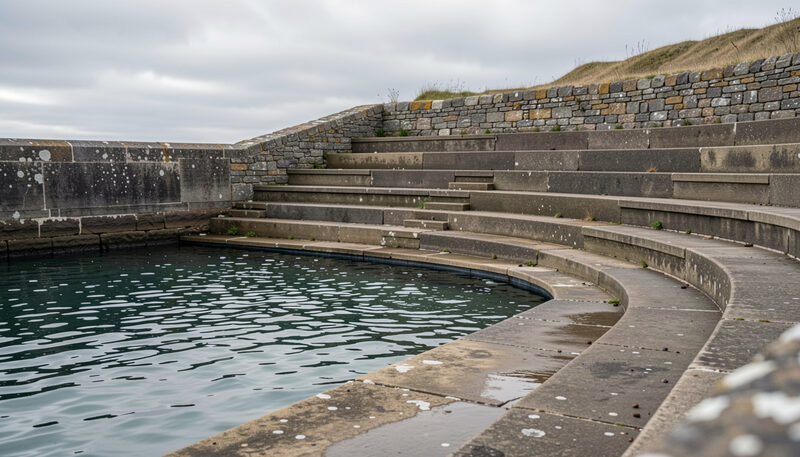
Burntisland is a small coastal town in Fife with an unusually long swimming history. It has had a swimming club since the nineteenth century and, for more than forty years, one of the finest open air pools in Scotland. This is a short, factual account of that history, drawn from public records and local sources, written for anyone curious about how swimming came to matter on this stretch of coast.
A club founded in 1886
Burntisland's swimming club was founded in August 1886. According to the club's own account of its origins, a group from the Lorne Club in Edinburgh chartered a steamer and crossed the Forth from Trinity. Their members put on a demonstration of competitive swimming, diving and life saving in the harbour at the West Breakwater, and the event was so well received that a local club was formed within a week. The club held its first competition shortly afterwards, with a Captaincy of the Club as the prize.
The club's full title included the words Humane Society, a reflection of the strong interest in life saving at the time. Teaching people to rescue others from the water was as much a part of the club's purpose as racing, and that emphasis on safety has echoed through the sport ever since.
The bathing pool at Lammerlaws
The most ambitious chapter in the town's swimming history was the open air bathing pool at Lammerlaws, on the shore. Preliminary work began in October 1935, and the pool opened on 6 June 1936. It was a substantial public project for a town of its size, built at a cost of around eleven thousand four hundred pounds by contractors William Taylor and Son of Glasgow, with John D. Swanston and the firm F and A Macdonald and Partner as consulting engineers.
The pool was designed for crowds. It had tiered seating for roughly fifteen hundred spectators, some of it under cover, which tells you how popular outdoor swimming was in the middle of the twentieth century. Along with other seaside pools around Scotland, it drew visitors to the town through the summer season for decades.
The fight to save the pool
By the late 1970s, the economics of running an outdoor pool had changed, and the local authority considered not reopening it for the summer. In 1979 a campaign was organised to save the pool, with local people, including young members of the swimming club, collecting signatures and staging a protest. Despite the effort, the decision to close was upheld, and the pool shut that year.
It was demolished after 1985. The site is now occupied by a modern leisure centre, which opened in 1997 and provides the town with an indoor pool. In that sense the town never lost its swimming water; it simply moved it indoors.
What the history shows
Three things stand out in this story. The first is how early and how seriously the town took swimming, with a club and a life saving society in the 1880s. The second is the scale of public investment in the 1936 pool, at a time when outdoor swimming was a mass activity. The third is the continuity: a town that built a bathing pool in the 1930s, fought for it in the 1970s, and replaced it with an indoor pool in the 1990s has kept swimming at the centre of its public life.
Burntisland's swimming club continues today, and the wider world it belongs to, the pools, the clubs and the competitions of Fife, is the subject of the rest of this magazine. The town's modern pool and how to reach it are covered in the guide to pools in Fife, and the coast that hosted the old bathing pool is introduced in sea swimming in the Forth. The detailed record of the 1936 pool, including its dimensions, costs and dates, is held by the Lidos and Pools UK archive at lidosandpools.uk.
A note on sources and dates
The dates and figures in this article come from public records and the club's own published history, and they are given as they stand in those sources. Where a figure is uncertain, it is described rather than stated precisely. This is a magazine, not an official history, and corrections with a source are welcome through the contact page.
Swimming before the pool
Before the bathing pool, and before indoor pools of any kind, swimming in Burntisland happened in the sea. The harbour and the shore were the town's swimming water, and the club's founders in 1886 swam and competed in the open Forth, watched from the West Breakwater. Cold water swimming is often described as a modern enthusiasm, but on this coast it was the original form of the sport, and the club's early life saving competitions were held in conditions that today's sea swimmers would recognise at once.
The coming of the railway in the nineteenth century made Burntisland a holiday destination, and swimming fitted naturally into a seaside town's summer. By the 1930s the demand for safe, supervised bathing had grown enough to justify a proper pool, and the result was the bathing pool at Lammerlaws.
The town's swimmers today
The swimming club that was founded in 1886 still exists, and the bathing pool's site is occupied by a modern leisure centre. The town's connection with the water has therefore never been broken, only changed in form. For a reader curious about the coast as it is now, the practical starting point is sea swimming in the Forth, and the safety knowledge that goes with it is in open water safety.